BMX Sprocket FAQ's
How To Find The Right BMX Sprocket
There are 3 things to consider when selecting a new sprocket to be sure it works with your bike: Mounting style, spindle size / sprocket bore size, and tooth size. We will break down each of these below to help you find a sprocket sure to work on your ride.
1. Mounting Style
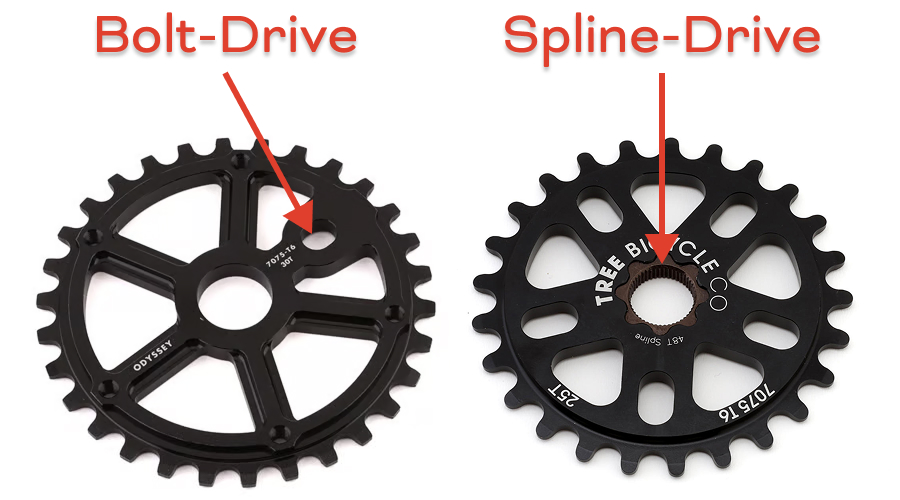
Freestyle sprockets almost always use a bolt-on sprocket. This means a sprocket bolt goes through a hole on the sprocket and threads in to the crank arm. This is what rotates the sprocket along with the pedal stroke.
Spline Drive sprockets are another option, but this style never really took off. This option is a boltless interface where the sprocket slides directly onto a crank spindle that has splines—small ridges or teeth—machined into it. The sprocket has matching internal splines, allowing it to securely fit without a bolt. While this method in theory worked great, compatibility amongst different manufacturers became an issue, so BMX stuck with the tried and trued bolt-drive option as the standard.
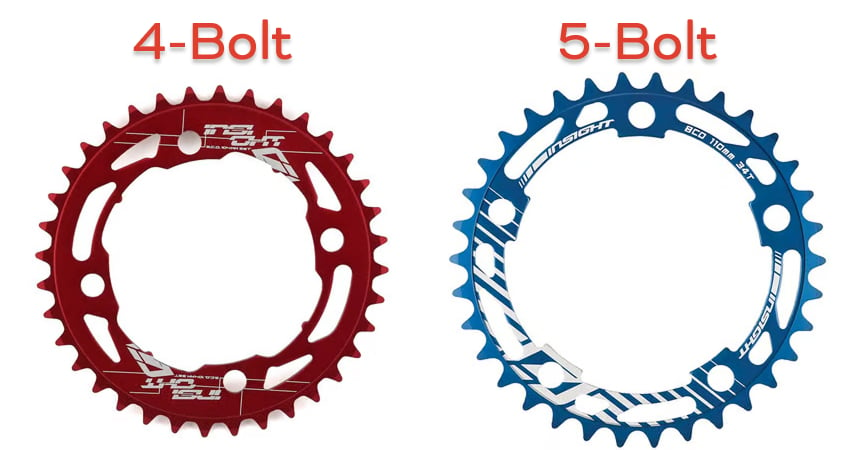
While BMX Racing does use bolt-on sprockets, chainrings are the most common style used here. Chainrings are typically larger and bolt onto a spider, which is a separate, multi-arm piece that attaches to or is built into the crank. Spiders usually have a 4-bolt or 5-bolt pattern and allow riders to easily swap chainring sizes for gearing adjustments. This setup offers more fine-tuned performance and is lighter for racing.
2. Spindle Size
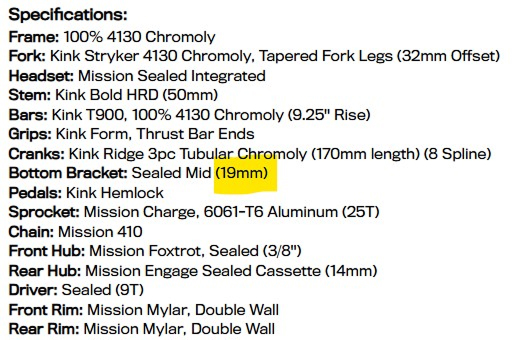
The next step is making sure the sprocket fits the spindle of your crank arms. In freestyle, this is either 19mm, 22mm, or 24mm (technically 15/16"). To make this easy, most sprockets come with the larger 15/16" bore and will include adapters to work with 19mm or 22mm spindles. This cuts out a step when shopping for a sprocket, just be sure to read the description and specifications of the sprocket as there should be a note to ensure it does include the correct adapter (most do, but not always).
If you're not sure what your spindle size is, you can either measure it's diameter, check the specifications we list on your bike or crankset (usually listed on the cranks or the bottom bracket's specs), or you can contact us and we'd be happy to help.
As mentioned, chainrings bolt to what is known as a spider rather than the spindle. These can have a 4 bolt pattern or a 5 bolt pattern.
3. Tooth Size
The overall circumference of the sprocket, in relation to the rear sprocket, determines how hard or easy the bike is to pedal. In the BMX world, this is sized based on the number of teeth on the sprocket. The teeth are always evenly spaced to fit a chain, therefore a 25 tooth sprocket is smaller than a 30T sprocket.
Gear ratio is a relative term used to indicate how far the bike will travel forward (in inches) with one revolution of the cranks. It is determined by dividing the number of teeth on the front sprocket by the number of teeth on the rear sprocket and multiplying by the wheel diameter. It is possible to achieve the same gear ratio by using different gear combinations. For example, up until the 2000's, 44-16 was the standard gear ratio. Once we learned to make smaller sprockets work, we could keep the same gear ratio with 25-9 sprockets. This allowed the bike to pedal the same but be much lighter and smaller, therefore less damage. To see our gear chart Click Here.
While racers often play this gear ratio game like a fiddle to get dialed in for each track, freestyle riders keep things pretty simple. 25T front and 9T rear is the standard. 28 x 10 is occasionally seen and has the same ratio. Some riders go a bit bigger on the front, sometimes up to a 30T, while sticking with the 9T rear. Some riders do this to allow for more top speed (great for trail riders or big park riders), others that like to do big moves to fakie (riding backwards) do it so they do not have to pedal back as quickly.
Unless you are experienced enough to have a good reason to change up your sprocket size, we suggest sticking with what came on the bike. Different sprocket sizes may require longer or shorter chains and can potentially run in to fitment issues.
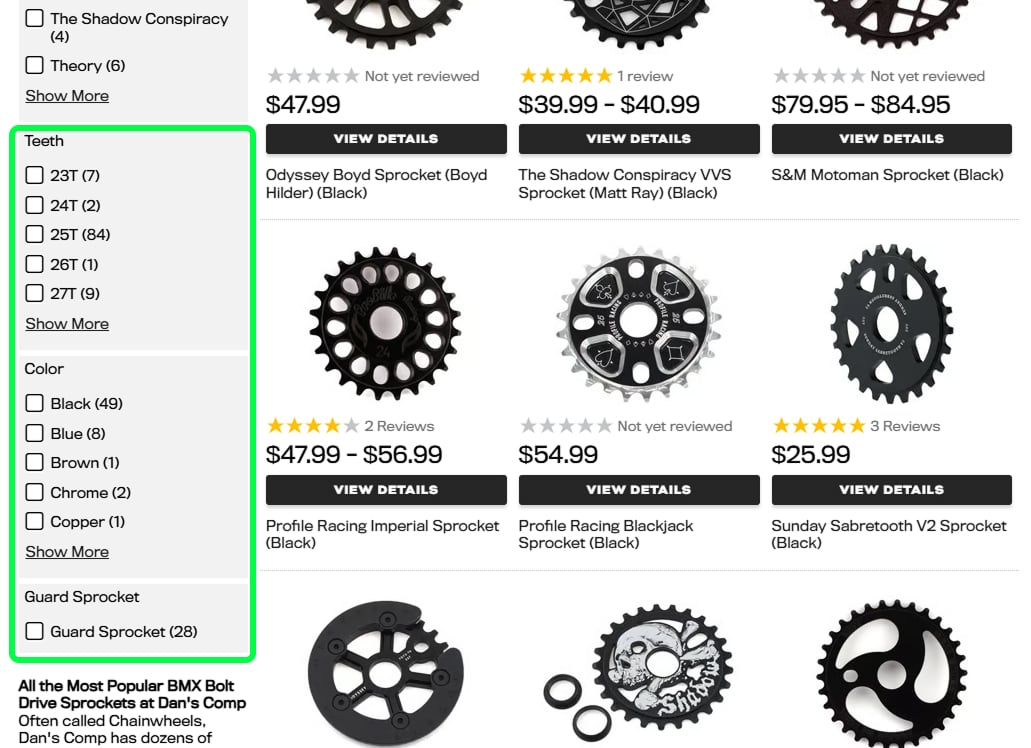
Additional Feature: Some sprockets include a built-in guard to protect the chain during grinds. You can use our filter tools to narrow down to just sprockets with guards.
Find The Correct Sprocket
Use the step-by-step guide below to get you to the correct category. Once there, use the filter options to narrow down you search. (See the graphic below to see how)