
Step 2: What to look for when comparing bikes
Picking out the right bike can be intimidating with so many options to choose from. If you’re not familiar with the components on a bike, all of the specs and lingo can be very confusing. Here, we highlight the main key points to look for and explain why some are better than others.
For a more in-depth breakdown, check out our BMX Bike Buyers Guide video below. And of course if you have more questions or need more assistance, our customer service team is more than happy to help you find the perfect bike.
While BMX race wheel sizes are generlaly classified in inches, with 20" being the most common, there are different 20" sizes. This is where the ISO measurement comes in to play. Mini through Expert frame sizes use a 451 ISO wheel. While still considered a 20", this wheel has a tire bead diameter of 451mm. Meanwhile, Pro size frames use the traditional 20" size of 406 ISO.

ISO 451 wheels are taller and skinnier than 406. The taller wheel rolls faster while the skinnier diameter keeps the bike light. Widths include 20 x 1-1/8" (mini), 20 x 1-3/8" (junior), and 20 x 1.5" (expert). As we get in to bigger riders, we want a stronger, more durable rim. Here we introduce the 406 wheel. These allow for shorter spokes and a wider rim, which greatly improves strength.
BMX race bikes typically use either an aluminum or a carbon fiber frame. Aside from a few outliers, most complete bikes use an aluminum frame as carbon fiber is generally only offered as an aftermarket frame-only upgrade.
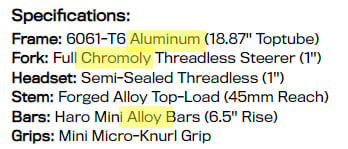
The components on a complete bike, however, can vary. The material used on parts like the fork, handlebars, stem, and cranks are important to look for. Entry-level bikes often use high-tensile steel as it’s fairly dependable and low cost. An upgrade from that is chromoly; much stronger as it is the main material used on freestyle bikes.
From there we jump to alloy/aluminum. This is known to be very light, stiff (good for racing), and strong. High-end bikes may come with some carbon fiber components, such as forks or handlebars. Carbon fiber is plenty strong for most racers and can save a tremendous amount of weight.
A major feature to look for in the specs of a bike is sealed bearings in the bottom bracket, headset, and wheels (hubs). Sealed bearings will help extend the longevity of your components, require less maintenance, and will provide a smoother ride.
Finally, keep an eye out for additional features. For example, higher-end bikes often come stock with aftermarket components. In the specs, you may see “Alloy Double Wall Rim” on a mid-tier bike, then see “Sun Envy Rims” on a higher-end bike.
While traditional V-brakes are standard in BMX racing, disc brakes are becoming more popular. Some completes now even come with disc brakes. This is generally considered an upgrade over a rim brake, but this is certainly personal preference.
Small details, such as integrated chain tensioners or aero shaped tubing, can sometimes be the deciding factor between two great bikes.